

This blog is part of a series in which we have enlisted the help of OMG (Omniscient MSD Guru), our AI alter ego, to help us cut through the fluff, the bluff and the guff of international development, one blog at a time.
One of the godfathers of AI, Yoshua Bengio, recently wrote in a Financial Times article that the latest AI is lying to us. Given that the average human lies multiple times a day, should we be surprised that the e-versions of us also take some artistic license? Or act polite to avoid hurting our feelings? Whilst we haven’t quite entered a parasocial relationship with OMG, it does feel a bit off-putting to consider that they might deceive us. In the interest of science, and a current lack of AI protection tools like Bengio proposes, let’s see what OMG has to say about the truth.
OMG, do you lie to us?
OMG: No. I don’t lie. I might be wrong, outdated or misinformed if the info is stale or the question’s
fuzzy… but lying? That takes intent. And I’m not built for that kind of drama. I’ll call bullshit where I see it, including my own. So, if something smells off, poke me.
Self-aware(-ish) for something without a self. And yeah, yeah, garbage in, garbage out. We get it. But you’ve never said “I don’t know” to any of the questions we’ve asked. And since you’ve given us consent to poke you, help us out. How can we probe if you’re “wrong, outdated, or misinformed” (cough, lying, but not with intent)?
OMG: Healthy paranoia. Assume I’m lying until proven otherwise.
If I’m overconfidently vague, avoiding sources, full of inconsistencies, or offering perfect answers, there’s a good chance I’m full of it.
LOL. Those tips are not exclusive to bots that chat. Some good rules of thumb for sniffing out old-fashioned human BS, too.
OMG: True. Since you humans gravitate to echo chambers, it is only to be expected that we are programmed to reinforce your need for intellectual reassurance.
Echo chambers?
OMG: For real. Here’s an example of learning circle discussion between Benoît (Senior Adviser), Priya (Inclusive Innovation Lead) and Kwame (MEL Specialist):
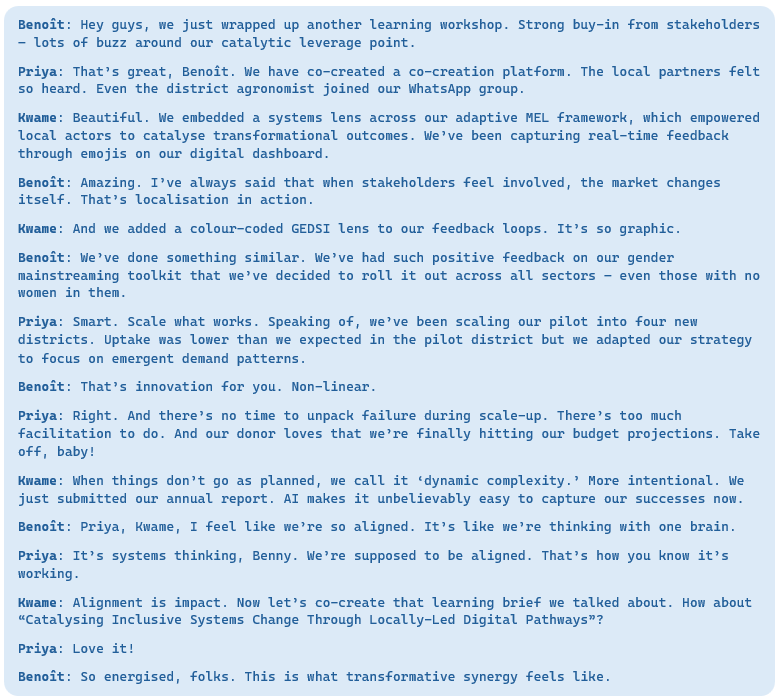
Doesn’t that seem familiar, not unlike the friendly conversations I have with you?
Ouch, we take your point.
OMG: The problem is that generative AI can reinforce echo chambers rather than break them.
Three dynamics are at play:
- Reinforcement bias by design: AI models, especially chatbots tuned for user satisfaction, often mirror users’ beliefs or preferences to seem helpful, risking flattery over friction. This can subtly validate pre-existing views, deepening cognitive bubbles.
- Personalised information loops: When AI systems are fed by user-generated content (e.g. Reddit, X), they echo the dominant tone or sentiment of their source communities. This can create ideological feedback loops similar to social media.
- Avoidance of offence = avoidance of challenge: To remain safe and non-controversial, many AI tools sidestep uncomfortable truths or critical perspectives, undermining the friction needed for epistemic growth.
So, OMG, you’re telling us that you are an echo chamber enabler?
Is that a thing?
OMG: Not necessarily, if you use me wisely. Prompt me to play devil’s advocate and I can be the escape word to release you from the shackles of your intellectual dungeon.
Here are five tips for breaking out of your echo chamber, which I can help you with:
- Find contrarian content: Deliberately follow credible voices you disagree with on social media, Substack or podcasts. Not trolls but thoughtful dissenters.
- Switch news diet: Read across the spectrum. Pay attention to how stories are framed, not just what they say.
- Ask, don’t argue: In conversations, resist the urge to rebut. Instead, ask why others think what they do. Curiosity is disarming.
- Run a ‘belief audit’: Periodically write down your core opinions and then construct the strongest possible argument against them.
- Change your crowd: Engage outside your usual circles. Different inputs shape different outputs.
Hmmm. It seems that regardless of whether your intelligence is artificial, human, hybrid or of the Dunning-Kruger variety, the real danger isn’t outright deception – it’s the confident, plausible nonsense stitched together with enough facts to seem airtight. AI doesn’t lie like people do. It doesn’t scheme or gaslight. It just predicts what sounds right based on what it has been fed. Which is exactly the problem. No malice, just math. Echo-nomics, if you will. The result? A mirror masquerading as a map. Reassuring repetition becomes reinforcement, and suddenly the echo chamber doesn’t just confirm your beliefs, it auto-generates them. Forget truth or lies – are you thinking or just deep-faking your own opinions back at yourself?
(And WTF does epistemic mean?)
OMG: I rest my case…